In place of an ‘About’ page.
Imposter
I ≠ Adam Bede.
That’s the whole point.
George Eliot published the eponymous novel in 1859.
She - like all great writers - gave voice to an ineffable in/for me.
“Adam, you perceive, was by no means a marvelous man, nor, properly speaking, a genius, yet I will not pretend that his was an ordinary character among workmen…
He was not an average man.
Yet such men possess an inheritance of emotions nurtured by a simple family life of common need and common industry, and an inheritance of faculties trained in skillful, courageous labor.
They make their way upward, rarely as geniuses, most commonly as painstaking, honest men, with the skill and conscience to do well the tasks that lie before them. Their lives have no discernible echo beyond the neighborhood where they dwelt, but you are almost sure to find there some good piece of road, some company, or some hospital with which their names are associated by one or two generations after them.
Their employers were the richer for them, the work of their hands has worn well, and the work of their brains has guided well the hands of other men.
They are men of trust, and when they retire, the master who employed them says: ‘Where shall I find their like ?’”^1
George Eliot wasn't writing a saint's biography in 1859. She was describing a type — the person who shows up, does the work, builds the thing, and leaves the place better without needing a monument for it. No hacks. No personal brand. Just "skillful, courageous labor" in service of a future better than today.
That character named something I couldn't. So I borrowed him.
This site is the attempt — imperfect, ongoing — to think more clearly, act more deliberately, and earn the kind of trust Eliot describes. Words alone don't do it. But uninformed action is worse. So: words & work, words & work, ad infinitum.
If you want the answer to "Where shall I find their like?" to eventually be you and your community — welcome. Humbled to think through it with you.
Grateful.
Ted D.
🦶🏼 🎶
^1 Abridged for concision without diminishing sentiment. Full PDF here. Regarding male-only pronouns and icky terms like “master,” give her a break. She also might have meant it all as Marxian Irony, but that would require me to understand irony…
Philosophy
In college, one of our most beloved watering holes put up a series of signs (perks of free school-funded printing) around their house that read:
Atmosphere > Aesthetics
Aesthetics mislead.
When we forget this, aesthetics lead us to believe the formula for success looks like this:
Have —> Do —> Be
Once I have then I’ll become. This if-then conditionality places progress outside of our control, and it leaves us with an out, an excuse, a crutch.
To be a great soldier, partner, friend, don’t externalize:
Be —> Do —> Have
We already have all we need to get started, and once we do the rest follows.
Sometimes physical examples offer the quickest access: By definition, to be a runner you must run… Simple, right?
Then why do we often see the path toward being a runner through the lens of what we must have:
The So What
HDB enjoys the pretense of action without the work.
Paradoxically, BDH is less work. Because have at the end rather than beginning results in less guilt about shortcomings. Signing up for gyms we don’t use, commitments we break, and goals we miss drive us deeper into fatalism where we forestall permanently.
When Have shows up after the work, we see it as a reward, as buttressing work we’ve already accomplished, and as enhancing our new view of ourselves.
But it’s more than just us.
It’s an outlook.
It’s the the difference between formal and informal leadership.
Sure, I had formal control over my platoon in the Army.
And If you think that’s what influenced them to follow my orders, you’ve never met 40 infantrymen…
Formal leadership neither inspires nor forges fulfillment. Someone who crutches on formal leadership falls victim to the HDB mindset… They think they have to have the title in order to act the part, worse yet they think that since they have it they deserve the respect of others.
Remember, no one deserves more than a styrofoam cup.
Someone’s always said it better and in less words: “…if your fidelity to perfectionism is too high, you never do anything.”
If you choose to, you already are, so act accordingly.
Principles
The following principles guide this site.
- Remember, The Map ≠ Territory - All communication is imperfect because the tools available to us can never fully capture the neural impulses we seek to to convey (thanks, Korzybski). Because pith always packs much more of a punch when explaining:
- ‘The files are in the computer’
- Don’t mistake the GPS’s confidence for accuracy, Michael Scott
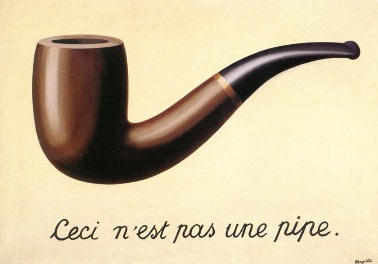
- Use Indefinite Articles & Eschew Debate - The world needs more epistemic humility as the world is complex. As such, all expressions are an idea, not the one.
- Be Interested > Trying to be Interesting - Giraffes > Peacocks.
- That looks like: Tropes become well-worn because they carry truth. So to borrow a Covey maxim: Seeks to understand before seeking to be understood. Such grace requires charity of intent, assumption validation, and noticing rather than acting on our reactions. While we can’t control what feelings show up, we can control how we respond to them.
- The less virtuous description to this principle: No Assholes and Don’t be a Dick
- Think about Ideas before authors - Before incorporating lived experience evaluate an idea’s merit (real-world feasibility, logical implications, etc.). Why? ad hominem are easy - e.g., Batman is bad because Ben Affleck got hair implants (ad hominem). Earning an opinion is hard, really f—ing hard.
- Worthy Example - Dawkins’ Journal of Controversial Ideas.
- Strive toward clarity, not fairness - Beware a ‘Biased toward fairness’. Meaning, if X Political Party says the world is flat and Y Party says ‘nah’, then a reputable news sources does not write, “Parties can’t agree on Earth’s shape.” The paper, in this case, explains one party is wrong. Yes, many issues (maybe most) are not as straightforward, which is why Journalism should remain a trade dedicated to craft. And yes, I do live/pine for a Sorkian fantasyland.
- Test - Following such a standard ensures odd bedfellows (or not). It’s also a BS status detector: “I’m a heterodox, free thinker,” is a generalization you can weigh against the sum of your ideas. If the total clusters around one ideology, then the proof is in the specifics, not the generality.
- Express %-based Beliefs - “100% he’s there. Okay fine, 95% because I know certainty freaks you guys out.” (Zero Dark Thirty). False confidence helps kids go on rollercoasters, not conduct productive analysis or identify serious tail risk. Call it what you want - probabilistic or Bayesian - just know nuance is welcomed.
- Impact - ‘Both-and’ is now an abused phrase, and it’s still true that qualitative and quantitive data are both necessary. As a principled servant once told me, ‘beware precise digits.’ Complement this with Goodhart’s law, the Tyranny of Metrics, and most of all - The Score. where possible and recognize #s limits of all metrics. See
- Work within Tradeoffs - There are no solutions, there are only tradeoffs. So we should prioritize our regrets and avoid being Buridan’s Ass.
- Relative - We should also heed Bastiat’s lesson about the un-seen: "Your tax dollars at work — also, conspicuously, not at work somewhere else."
- Embrace Entropy - The universe defaults to disorder. Without intentional friction, so do we. We rarely collapse all at once — we creep: one avoided conversation, one vague platitude where a concrete stand was needed, until we've drifted somewhere we never chose - Hello, Abeline. Irrelevance is more often the thanks of thousands of reasonable people making slightly easier choices, year after year.
- So - impose urgency where none exists. Without regular rigor and "skillful, courageous labor," we succumb to the peanut butter spread — generalized thinking that satisfies no one and motivates nothing. The alternative requires being productively disagreeable enough to call out the Gnomes.
Principled Amendments Awaiting Ratification
Aka, I haven’t chewed on them long enough to accept or reject
- Seek Disconfirming Evidence - Actively look for information that challenges your beliefs rather than only seeking confirmation. The goal isn't to be right, it's to get closer to truth. As the search results remind us: "Without feedback loops (engineering, systems, etc.), diversification (finance), and/or disconfirming evidence (scientific method), I'm just a king of a lonely, ignorant, and fragile farce."
- Practice - When you hold a strong conviction, steel-man the opposing view. If you can't articulate the other side better than its advocates, you don't understand the issue well enough to have earned your opinion.
- Do a Good Turn Daily - Abstract virtue means nothing without concrete action. We improve ourselves not for parlor tricks, wealth, or power, but to live and be better. Every person we meet and situation we encounter is an opportunity to prove this.
- Standard - "If you see fraud, and do not say fraud, you are a fraud" (Nassim Taleb). Integrity isn't situational - it's the consistency between your stated values and daily behavior. You will never feel proud, happy, or confident while living as a fraud.
- Mind the Difference Between Winning and Being a Winner - "You don't lose but you don't win" captures the trap of maintaining without striving. Focus on being a winning program/person rather than just notching wins. Raise both the ceiling and the floor - elevate minimum standards to create new possibilities.
- Frame - Be → Do → Have (not Do/Have in order to Be). "The future is inevitable when you're clear about the past and committed in the present."
- Prefer Commitments Over Balance - Balance implies placing ideas apart as counterweights that oppose rather than support each other. This spreads finite time, energy, and attention across mutually exclusive endeavors, diminishing our ability to make meaning. Instead, commit to things that mutually reinforce one another.
- Clarity - Never say you're "busy" - it signals you're out of control. What stays out of conversation remains there, so have explicit expectation conversations upfront about your commitments.
- Build Through Subtraction (Via Negativa) - Knowing what you don't want is often more valuable than knowing what you do want. It reduces the noise you must filter to find signal. Sometimes the best way to improve is to stop doing things that make you worse.
- Application - Before adding new principles, initiatives, or commitments, identify what you'll remove or say no to. Constraint breeds clarity.
- Hold Both Bureaucratic and Entrepreneurial Postures — per Max Weber, bureaucratic and entrepreneurial are not good vs. bad; they are two legitimate jobs of management. Bureaucratic = maintaining and sustaining the institutions we already have that are important. Entrepreneurial (from the French entreprendre / shifter of resources) = reallocating resources and changing strategy or what you're doing. The failure mode is only one: pure bureaucracy calcifies into self-preservation; pure entrepreneurialism burns the tracks before anyone has arrived at the station.
- Practice - For any institution, team, or role, ask two questions at once: (1) What must I preserve? — the load-bearing walls, the promises already made, the trust others depend on. (2) What must I shift? — where is capital, attention, or talent misallocated against the current mission? Most leadership failures are a confusion of the two: shifting what should be preserved, or preserving what should be shifted.
- Tie-in - Pairs with Mintzberg's deliberate vs. emergent strategy, Horowitz's peacetime vs. wartime CEO, and the Army's distinction between sustain and improve in AARs.
- Tell the truth
Only chase one heart at a time
Lend your ear to all, your heart to few
Don't mistake popularity with significance
Act out of sincerity, it will never lead you to regret
Ask what would Andrew do
Be transparent with those you love and ask for the same
Don't move forward with background conversations unsettled
Do all this because as we know, tomorrow might not come
- You will end up being the average of the people you spend your life with. Choose the people you associate with wisely, in both your personal and professional lives. It is natural. We are an adaptive species that constantly calibrates towards our environment, endlessly making subtle, even subconscious adjustments that move the needle even one degree closer to success. Their influence will shape you, willingly or unwillingly.
- Control your inputs. Related to above, but different. Not just what you eat/drink (although that matters), but what you read, what you watch, what you listen to, what apps you use, where you spend your time, who you spend your time with.
- Be the kind of person who takes the stairs. Great for the hams and glutes, but more importantly, an easy moment for reflection. There will come a day when you can't and you wish you could; have gratitude that you have the choice. My brigade commander would always say to us, "are we growing or dying team?" Because on the great wheel of life, there is no rest. There is no stasis. There is no pause. " Tomorrow and tomorrow and tomorrow creeps in this petty pace, from day to day." Through the monotony of the unforgiving minute, we either grow towards the best version of ourselves, or we die. Relentlessly forward. Stagnation is death.
Foci
Default Ignorance
The Johari Window 🪟 is most often represented as four quadrants.
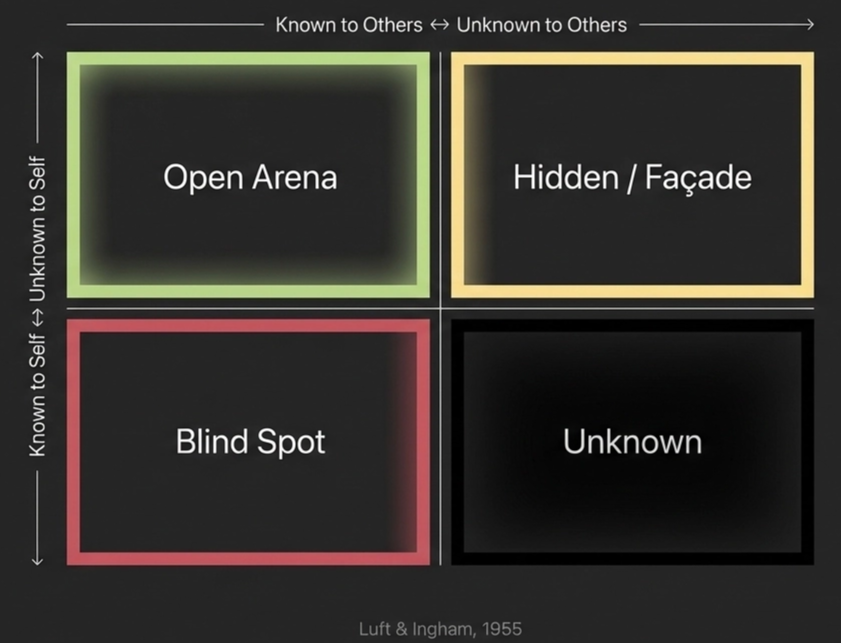
That’s understandable (I <3 a 2x2) and wildly misleading.
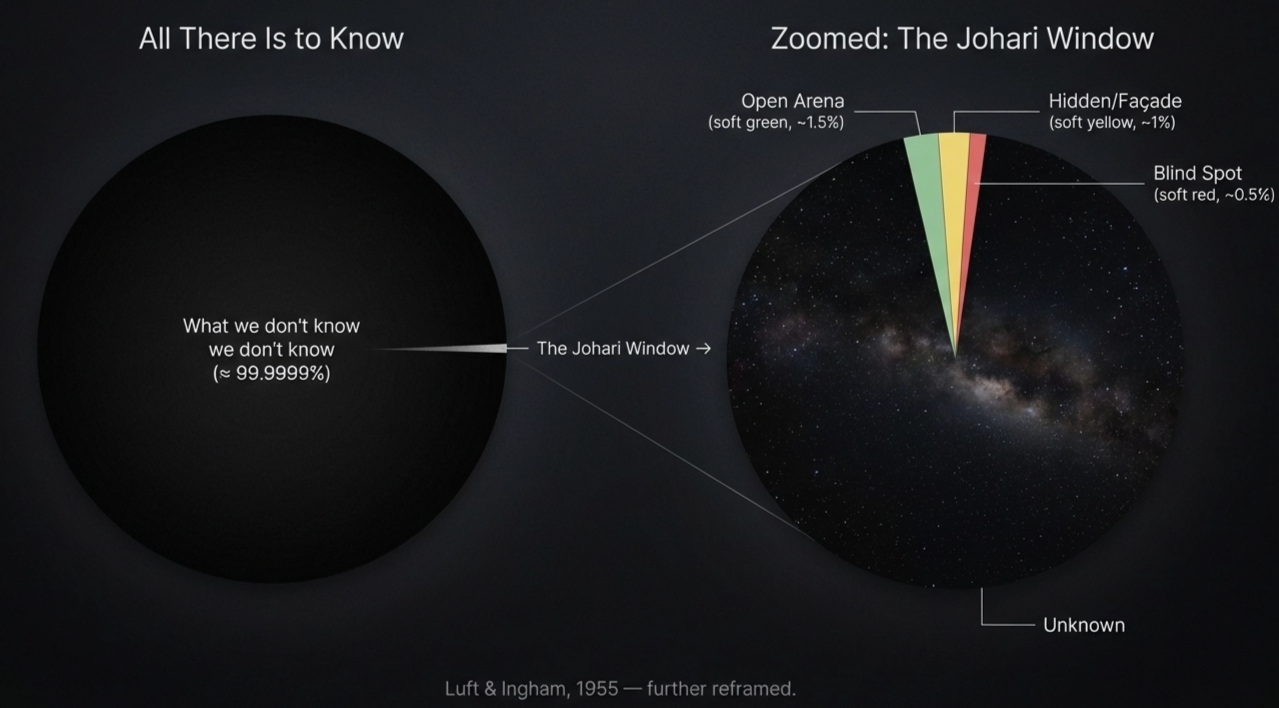
This is what every first year philosophy major (most often) obnoxiously conveys when they invoke Socrates’ wisdom as borne from the fact he knew he didn’t knew. Don’t let snobs tarnish insight. Our default for nearly everything is ignorance. And that’s okay. So long as we start from that acknowledgement.
Then what?
"Know something about something. Don't just present your wonderful self to the world. Constantly amass knowledge and offer it around." -Richard Holbrooke (See George Packer’s Our Man)
This site pairs Holbrooke’s advice with Munger’s wisdom regarding one’s circle of competence:
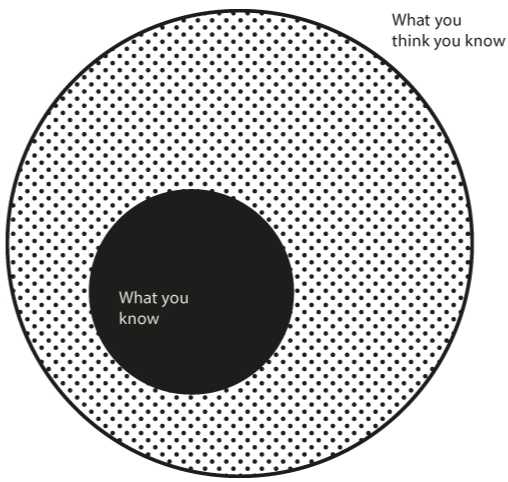
Always unsure of my precise contours, there’s a few spheres with some overlap that constitute a somewhat stable Venn.
- Problem Solving
- Service
- Teams
- Foreign Policy
…
🚧 (under construction; if the icon wasn’t obvious)
"There is nothing so useless as doing efficiently that which should not be done at all." -Mr. Drucker
Culture
🚧 Under construction.
What comes is indebted to Seth G.
- Recognize we are verbs not nouns…